Monday, September 5, 2011

"Black Friday" - The Great Gold Crash...Of 1869

When one thinks of gold crashes, one typically visualizes a trading floor from the 1980s onward, predicated by Nixon's nixing of Bretton Woods 40 years ago, which removed gold from the list of accepted currencies and converted it into a government-manipulated pariah, whose core function was to be suppressed in an ongoing (failed) attempt to make the dollar the undisputed reserve currency (something even China comprehends). Well, readers may be surprised to discover that one of the first, and probably biggest on a relative basis, documented gold crashes was not 3 weeks ago, nor back in October 2008, nor any time since the advent of Nixon, or even the Federal Reserve, but over 140 years ago, on September 24, 1869 when a massive gold price manipulation scandal created a financial panic. That day, also known as "Black Friday", was the culmination of an attempt to corner the gold market following the latest, however brief, termination of the gold standard, when during the reconstruction period following the US Civil War, the US dollar was backed not by gold, but simply by credit (sound familiar). The result was a surge, and then collapse in gold.

What is the take home, if any? Perhaps that any time the government attempts to interfere with gold's status as a natural safety currency, it is not only gold price discovery that suffers, but virtually every other asset class, as central planning once again tries to order capital flows, however inefficiently, always, and without fail, leading to financial catastrophe.

The chart below demonstrates the intraday swing from that long ago Friday 142 years ago:

For those curious to learn about one of the first record gold price manipulations... and crashes, can do so below, courtesy of Wikipedia.

Black Friday, September 24, 1869 also known as the Fisk/Gould scandal, was a financial panic in the United States caused by two speculators’ efforts to corner the gold market on the New York Gold Exchange. It was one of several scandals that rocked the presidency of Ulysses S. Grant. During the reconstruction era after the American Civil War, the United States government issued a large amount of money that was backed by nothing but credit. After the war ended, people commonly believed that the U.S. Government would buy back the “greenbacks” with gold. In 1869, a group of speculators, headed by James Fisk and Jay Gould, sought to profit off this by cornering the gold market. Gould and Fisk first recruited Grant’s brother-in-law, a financier named Abel Corbin. They used Corbin to get close to Grant in social situations, where they would argue against government sale of gold, and Corbin would support their arguments. Corbin convinced Grant to appoint General Daniel Butterfield as assistant Treasurer of the United States. Butterfield agreed to tip the men off when the government intended to sell gold.

In the late summer of 1869, Gould began buying large amounts of gold. This caused prices to rise and stocks to plummet. After Grant realized what had happened, the federal government sold $4 million in gold. On September 20, 1869, Gould and Fisk started hoarding gold, driving the price higher. On September 24 the premium on a gold Double Eagle (representing 0.9675 troy ounces (30.09 g) of gold bullion at $20) was 30 percent higher than when Grant took office. But when the government gold hit the market, the premium plummeted within minutes. Investors scrambled to sell their holdings, and many of them, including Corbin, were ruined. Fisk and Gould escaped significant financial harm.

Subsequent Congressional investigation was chaired by James A. Garfield. The investigation was alleged on the one hand to have been limited because Virginia Corbin and First Lady Julia Grant were not permitted to testify. Garfield's biographer, Alan Peskin, however, maintains the investigation was quite thorough. Butterfield resigned from the U.S. Treasury. Henry Adams, who believed that President Ulysses S. Grant had tolerated, encouraged, and perhaps even participated in corruption and swindles, attacked Grant in an 1870 article entitled The New York Gold Conspiracy.

Although Grant was not directly involved in the scandal, his personal association with Gould and Fisk gave clout to their attempt to manipulate the gold market. Also, Grant's order to release gold in response to gold's rising price was itself a manipulation of the market. Grant had personally declined to listen to Gould's ambitious plan to corner the gold market, since the scheme was not announced publicly, but he could not be trusted. Gould had promoted the plan to Grant as a means to help farmers sell a bountiful 1869 wheat crop to Europe.

A highly fictionalized account of Fisk's life, culminating in a dramatic presentation of the gold corner, was shown in the 1937 film The Toast of New York.

Friday, September 2, 2011

Where does gold go from here - $1,500 or $2,000?

For the last week and more gold has been on a roller coaster moving between $100 and $200 each way until now where it is hovering above $1,800. A broad spectrum of analysts points either to $1,500 or above $2,000. With gold currently just above $1,800 we are around the half-way point for each move. The move each way would represent a move of just over 16%, which is not deeply significant in today's gold world except for the trading fraternity; there is more, however, beneath these moves than meets the eye!

$1500 Implications

  • The fall to $1,500 is only 16%+and would therefore not represent a change of trend to us.
  • Should the price only fall to $1,650 it would be a correction caused by significant selling in the face of rising seasonal demand.
  • A fall to $1,750 would be large buyers standing back and shaking out weak holders, who are, primarily, holding gold in the U.S. based SPDR gold ETF. They sold 50 tonnes last week.

U.S. Involvement in the Gold Market

The holders that sold gold from that ETF could be one of two types. Either a holder who took advantage of the sudden jump over $1,910 sold into strength heavily, as part of an ongoing sales program, or a broad spectrum of U.S. sellers, believing that neither inflation nor deflation is a future danger for the U.S.

Either way, buyers outside the U.S. welcomed the supply and absorbed the amount quickly. This resulted in the fall from $1,910 to $1,716 and then a race back over the $1,800 line again. The significance is that the price correction/consolidation is a movement of U.S. long-term holder's gold into central bank of Eastern demand hands.

What has been remarkable in the gold price rise is that U.S. demand for physical gold has been negligible. Compared to the original growth in the U.S. gold ETF the demand this year and last year has been modest against the initial rises in the holdings.

The behavior of the holdings has reflected not just the conservative nature of the fund but some of the investment policies of the investors. Take the holdings of George Soros. After taking his position he has decided that deflation is not a danger and has dropped his physical holdings in favor of gold shares. The switch appears reasonable in the light of the poor performance of gold shares relative to gold itself and the reality is that he did not drop his exposure to gold at all. But he remains invested in gold. The amount of buying to sell for a profit in the medium term is small and is expected to remain so. At these levels it represents less that 1% of the total investment funds in the U.S. (more)

Wednesday, August 31, 2011

Can anything stop the Swiss franc?

The Swiss franc just won't quit.

The currency jumped more than 2% against the euro and the U.S. dollar Wednesday after the Swiss government announced a stimulus package that was smaller than investors had anticipated.

While the currency's strength diminished in August, it is still up 9% against the euro and 13.5% against the dollar so far this year.

The Swiss franc has appreciated as investors sought out safe-haven investments amid the waves of uncertainty that have hit markets this year.

But the currency's strength is causing major problems for the Swiss economy.

A strong franc makes Swiss goods less attractive to trading partners, and tourists -- a major source of income for Switzerland -- are less likely to visit.

"The largely overvalued Swiss franc against the euro and the dollar poses great challenges for certain export-oriented sectors ... like manufacturing and tourism," said Swiss economic minister Johann Schneider-Ammann earlier this week.

Complicating matters, the country's central bank chose to leave its money supply unchanged on Wednesday.

"Where the franc goes from here depends on what the Swiss National Bank does and developments coming out of the eurozone," said Brian Dolan, chief currency strategist at Forex.com.

In early August, the franc's sharp rise prompted the Swiss National Bank to step in to try and cool the rally.

The Zurich-based central bank cut interest rates to "as close to zero as possible" and boosted the supply of Swiss francs to money markets.

At the time, the bank said it considers the franc to be "massively overvalued," and that its strength "is threatening the development of the economy and increasing the downside risks to price stability in Switzerland."

Not that much has changed. The currency is still very strong, but the brief weakness in August might have given the central bank pause.

The Swiss National Bank "still has plenty of options" to control appreciation, Dolan said.

The bank could levy a tax on foreign deposits, making it more expensive for investors to hold francs. Or the bank could move to negative interest rates.

"The Swiss need to be continually applying pressure on markets to prevent another surge," Dolan said. "The more they step back, the more investors will move back into the franc."

Tuesday, August 30, 2011

Protect Yourself From Rising Food Prices : AGU, COW, CROP, MOO, PAGG


Many consumers have recently felt the effects of rising oil prices in their wallets. With turmoil continuing to rage in the Middle East, oil prices have been volatile. Funds like the United States Brent Oil (NYSE:BNO) have rallied in the face of higher prices. Analysts predict that this trend of higher oil prices could continue for awhile as the political situation in the Middle East remains in a quagmire. However, while consumers focus on the gas in their tanks, a potentially more serious problem is still brewing - rampant food inflation.

Biggest Increase

The United Nations Food and Agriculture Organization's (FAO) latest report showed that global food prices rose 39% in June versus June 2010. So far, consumers in the United States have not really felt the full effects of this rising food price inflation. Recent weather calamities such as a drought in Russia and flooding Australia, have disrupted harvests and helped push food prices higher. In addition, long term demand from emerging nations for new sources of food and biofuels is putting continued pressure on food prices. The USDA estimates that throughout 2011, its all-food CPI will increase 3 to 4%, with food at home (grocery store) prices forecast to rise 3.5 to 4.5%. The USDA forecasts are based on strengthening global food demand, mostly in the developing world.

Emerging World Demand

That demand in the emerging world is growing quite rapidly. The FAO projects that global populations will increase nearly 11% by 2020 and 20% by 2030. Analysts at Goldman Sachs expect the global middle class to expand considerably over the same time frame, to over 3.5 billion by 2030. Worldwide demand for beef is at all time highs, with beef exports surging by 19% in 2010. Wheat imports in China will need to rise by more than 30% this year. Last year, China was a net importer of corn for the first time in 14 years. Unlike developed nations such as the United States, citizens of emerging nations can spend as much as 40 to 50% of their income on food.

Sowing the Seeds

With the trends pointing in the favorable direction, investing in agriculture has been a big hit. While many agricultural commodity prices have climbed already, investors with a long term focus should consider adding the sector to a portfolio. Both the Market Vectors Agribusiness ETF (NYSE:MOO) and the PowerShares Global Agriculture (Nasdaq:PAGG) offer broad global exposure to some of agriculture's biggest companies like Deere (NYSE:DE) and fertilizer maker Agrium (NYSE:AGU). These two funds can form a great base in sector. However, there are other ways to play the growth in Ag.

The agricultural sector accounts for a big portion of total economic activity in both New Zealand and Argentina. Argentina is the second largest corn exporter and third largest soy exporter in the world. The nation is also top beef and lamb producer. New Zealand has seen its milk exports to China rise more than five times since 2008 as rising incomes increase demand. Both the iShares MSCI New Zealand (Nasdaq:ENZL) and Global X FTSE Argentina 20 ETF (NYSE:ARGT) should do well as the Ag sector grows.

Higher beef prices may be here for awhile as it takes two to three years for a cattle rancher to substantially increase herd. The U.S. currently has the smallest cattle herd since the 1950s, even though exports are surging. The iPath DJ-UBS Livestock ETN (NYSE:COW) and UBS E-TRACS CMCI Livestock ETN (NYSE:UBC) allow investors to bet on the prices of livestock.

Bottom Line

With global demand surging, higher food prices are here to stay. Investors with long term timelines should consider the sector. Growing populations, coupled with the newly minted middle classes desire for new sources of protein makes the sector a great place to be for the next few years. Funds like the new IQ Global Agribusiness Small Cap (Nasdaq:CROP) should continue to do well as global populations increase exponentially.


Palladium Price Lags Gold

Unlike gold, which has rallied recently, the price of palladium has underperformed other precious metals over the past few months. Although palladium wsa one of the best performing commodities last year, signs of an end to its rapid price recovery are growing. According to the latest report of the German precious metals trading group Heraeus, Exchange Traded Funds (ETFs) got rid of nearly four tons of palladium in the last four weeks. While global demand for palladium bars for investment purposes has slightly increased, the total volume remains at relatively low levels.

Palladium was one of last year´s biggest winners after the global automobile industry had significantly recovered again. While the global financial crisis caused a heavy setback in worldwide car production numbers, the industry was able to rebound in the last two years. Even if sales figures in many regions could not reach their pre-crisis levels again, palladium demand among industrial end-users turned out to be strong. This development contributed to palladium price rally, after hitting a low of $161 per ounce in the fall of 2008. Palladium reached a new record high of $855 per ounce in February of 2011; more than a fourfold increase compared to its bottom at the height of the global financial crisis.

In addition, the rally in the palladium market has been fueled by growing concerns over future supply shortages of the white metal. After the mining giant Norilsk Nickel warned of depleting Russian state inventories of palladium in autumn 2010 followed by strikes in South Africa, the largest producer, this contributed to a tightening of the supply situation in global palladium markets. However, the resulting fears among global capital investors have given way to greatly increasing concerns over a new recession in the United States and a significantly slowing global economy in recent weeks. A shrinking demand from the automobile industry would have a highly negative impact, which is primarily used in the manufacture of catalytic converters.

The report from Heraeus also stated that sales in Europe´s automotive sector decreased by 2% from January to July of 2011. While Germany´s car market has proven to be a stabilizing factor for European car sales in the respective period, new vehicle registrations severely fell in those countries most affected by the region´s sovereign debt crisis. Spain, Italy and Great Britain suffered a slump of 24%, 13%, and 6.7% respectively. While vehicle sales in the U.S. rose by 11% compared to July 2010, new car registrations only increased by 1% month-on-month. Similarly in China – the world´s fastest-growing car market – vehicle sales recently posted a drop. Should this situation not change soon, the risk for a continued decline in palladium prices is high. Thus, investors should be extremely cautious were the technically relevant support level of $720 per ounce to be lost.

Monday, August 29, 2011

The World’s Supreme Test for Gold

gold is money“Gold is now at its supreme test of desirability. Either it will become much more valuable, or the trend will be away from it altogether. And today economists are not agreed on which will happen; but the opinion is strong that there will be a drastically revised conception of the virtues of gold.”

This excerpt comes from The Vancouver Sun of October 1933. It is a fascinating article. I strongly recommend that you read it in its entirety here. (It should take you no more than 3 minutes to do so.)

The article wrestled with one economically-perplexing question: Did gold become money because people wanted gold in a “special way” or is gold wanted by people just because gold is considered (legal) money? The article remarked that some economists believe it is the former, while others believe it is the latter.

The article---and its question posed---must be understood in context, however. In April of 1933, U.S. President Franklin D. Roosevelt ordered that all gold held by American citizens was property of the United States Treasury and, as such, by May 1933 all American citizens must turn in their gold to the Federal Reserve and/or an affiliate banks.

In other words, gold was no longer deemed (lawful) money in the United States. The article, therefore, pondered the question: Would the demand for gold remain even though the metal was no longer considered money?

The article’s author took the position that, regardless of if gold is deemed legal money, people want gold and that is what ultimately drives its demand. But gold was still considered money in other countries like France, Italy, Belgium, Germany, Holland, and Switzerland. In fact, the author noted that “Frenchmen” were regularly entering into the London Gold market to purchase gold even though it cost those business men a heavy premium compared to simply redemption at their own Bank of France. Why pay this premium?, the author asked. No need to ask why; just note that it is happening, the author said.

But what if the above-mentioned countries followed suit with the US and Britain and made gold “not money” anymore? What then for the demand for gold?

Time will tell, the author concluded.

Let us hope that if [the test of gold] materializes we shall profit by its lesson, for that lesson will be of great importance in clearing people’s minds upon some fundamental principles concerning the nature of “money”---and its “management.”

The author would be satisfied to know that history has answered this question and, in addition, has vindicated his position---that gold is desired and wanted by the people not because it is deemed legal money but because it is the truest money. After 70 years, history has proved that people desire gold regardless of what governments call it or deem it.

And right now---at a gold spot price at about $1900 per ounce---the people are showing their strong desire for gold is only beginning to be rekindled. The “supreme test” of gold has been completed. But it has not ended. Not until, that is, gold has been deemed “legal” money once again.

Gold is money.

Low Rates Are Goodand Bad

Borrowers breathed a collective sigh of relief when the Federal Reserve said earlier this month that it would hold interest rates at rock bottom for the next two years. But savers were far from happy.

"The news was a little depressing" for savers, says Jim Chessen, chief economist at the American Bankers Association. "It means low savings rates will be par for the course for the next couple of years."

A divided Federal Reserve conceded Aug. 9 that the economy was weak, with "downside risks" on the rise, and announced, surprisingly, that it would extend near-zero short-term interest rates another two years.

The Fed sets a "target rate" that banks follow closely when setting the "federal-funds rate" they charge each other for overnight loans as well as the competitive interest rates they charge consumers and businesses.

The Fed's move was aimed at goading consumers and businesses to look again at leverage as a means of investing in the economy -- either through big-ticket purchases like houses, cars and large appliances, or, for businesses, in equipment, new systems and even workers. The Fed's thinking is that if interest rates stay low enough, people and businesses won't be afraid to borrow, which could shake this stagnant economy back into growth mode.

But it stings if you're on a fixed income facing rising costs for energy and food, or if you're so wary of your money disappearing in the stock market that you're sitting on a bank savings account full of cash. Most bank-savings rates are below 1%.

Low interest rates hurt, too, if your retirement is dependent on interest income from certificates of deposit. Interest rates on a one-year CD have plunged to 0.42% from 2.38% just three years ago, according to Bankrate.com. Most money-market mutual-fund yields are at 0.01%. And at those rates, there's no wiggle room for inflation, which was 3.6% in the last year.

"It doesn't matter if your money is liquid or tied up in a CD, the yields right now do not compensate you for inflation," says Greg McBride, senior financial analyst at Bankrate.

Though the interest is adding only dimes and nickels to many savings accounts now and for the next two years, a federally insured bank is still a good bet to stash your cash.

If you're a homeowner with, say, a 5-1 adjustable-rate mortgage that's already past five years of the fixed-rate portion, you're in pretty good stead for the next couple of years.

Ditto on those home-equity lines of credit, which carry variable interest rates mostly based on the prime rate, which also trends with the federal-funds rate.

Low interest rates also have contributed to 50-year troughs in mortgage rates, which are determined by a variety of interest-rate benchmarks. Freddie Mac reported the average rate on a 30-year fixed-rate mortgage rose modestly last week to 4.22%, after seven straight weeks of declines. A year ago, the 30-year fixed-rate mortgage stood at 4.36%. The 5-1 ARM slipped to 3.07%, a record low.

Low interest rates are a positive for credit-card holders, unless, of course, you don't pay your bills on time and get slapped with high penalty rates. Thanks to the Credit Card Accountability, Responsibility and Disclosure Act, most banks reset their annual percentage rates to variable terms, meaning they could rise -- and fall -- along with the prime rate.

"It doesn't look like there's going to be any cost-of-funds pressure on credit-card issuers to increase" annual percentage rates, says Ben Woolsey, director of consumer research at CreditCard.com. The cost of funds refers to the rates banks charge each other on overnight loans. "It appears that banks are opening up more credit to people with excellent credit."

A low-interest environment makes it even more important that you pay off your credit-card balances, however. Because you're earning very little return on savings accounts and CDs, the amount you pay in interest-rate charges has more impact on your total budget and cash flow. Generally, interest earned on savings accounts can help offset the interest paid on credit cards.

Sunday, August 28, 2011

9 Steps to Take If You Fear a Job Layoff

If you notice warning signs at your company that clearly say, "Somebody's going to be leaving here on short notice," don't wait until you're handed a pink slip to start thinking about your next career move.

Here are nine tips that can help make a layoff less traumatic, and put you on track to quickly land a new job.

Assess Your Next Move

It can be unnerving to show up for work every day knowing that a layoff is looming. Help relieve some of that tension by taking stock of your professional situation. Ask yourself:

1) If you had to change jobs quickly, would you pursue the same type of assignment you have now?

2) Where would you focus your job search and how would brand yourself for the next project?

3) What have you learned on your current job that could be beneficial in your next venture?

4) Would you consider independent consulting — perhaps even for your soon-to-be former employer?

Revive Your Resume

An effective resume nowadays draws a smooth line between your background (highlighting your entire career, not just your current role) and the positions you're targeting in your job search. If a layoff is, indeed, in the works at your company, you'll want to rewrite your resume to focus on the relevance of your previous jobs in relation to the positions you're pursuing now.

For example, if you've spent several years in human resources, but prefer accounting and want to highlight that aspect of your skill set, under your current job functions, showcase the accounting-related work you've done.

Update (or Create) Your LinkedIn Profile

New users should get comfortable with LinkedIn.com, which is a social networking site targeted towards professionals, by joining a group, answering a question on LinkedIn Answers, adding a blog or other content to your profile, and using the search capabilities of the site's massive database.

Before you change anything on your profile, however, go to the settings and turn off outgoing notifications to your network. Doing this allows you to work on your profile without alerting the whole world. Update your profile with details on your current job, update your picture if it needs freshening and cultivate some new connections while you're at it.

Expand Your Network

Most employed people (sans entrepreneurs) don't network nearly as much as they should. If your senses are telling you that a job change is likely -- whether you want it or not -- it's time to reconnect with former colleagues and make new professional acquaintances.

That means at least one breakfast or lunch per week with someone you know. Remember to talk about what's new in both of your lives, and if you're comfortable, gently request an introduction to second-degree friends who should be a part of your professional network.

Get to Know a Respected Headhunter

Every white-collar job-seeker needs a headhunter in their corner. If you're not already on the short list of at least one search pro in your industry, make a new friend who fits that description. You can meet them through friends or find one online and initiate contact.

Headhunters will be able to provide you with feedback about your resume, let you know what your background is likely to fetch in the marketplace and tell you about local firms with open positions in your field. As long as you respect their time and remember that job-seekers don't pay their salary -- employers do -- you'll find a search partner that's a valuable ally.

Determine Your Value

Most people who've been employed at one company for many years have no clue how much they're worth in the current job market. Use sites such as Glassdoor.com, Salary.com and Payscale.com to help determine an appropriate salary amount for your experience level. You'll need that information when an employer asks what you're looking to earn. Many industry-specific publications, such as InfoWorld (for IT pros) and Adweek (advertising folks), publish an annual salary survey that can help provide a better idea of what your asking price should be.

Mobilize Your References

Even if a layoff is in the very near future, your current employer can still give you something incredibly valuable in the form of references from fellow colleagues. Start cultivating your reference list now, and include at least one co-worker, a customer or vendor you've done business with over the years and a subordinate. If you can make contact with a former boss, that's even better. If there are colleagues you'd hope to stay close with assuming the worst, get their personal e-mail addresses and phone numbers, too.

Start Your Job Search

Take a look at Indeed.com and SimplyHired.com, two major job aggregation sites, to see what employers in your area are looking for. Research specific employers by trolling LinkedIn to see who's working where, how certain employers fare in their competitive arenas and what companies are looking for as they grow their teams.

Once you've figured out what direction you want your job search to take, test the waters by applying to positions online. Remember, employers prefer job candidates who are already employed.

Don't Be Afraid to Ask

If you do learn that your position has been eliminated, immediately discuss critical details, such as severance pay and health benefits coverage, with your manager. Determine whether terms are negotiable. Keep your cool during this conversation, but insist on complete answers. If your manager can't give them, then ask who can. While getting laid off can be an emotional and confusing time, it can be made even worse if you fail to ask questions and take the necessary steps to prepare.

Storm Pennants Are Flying In Stocks And The Dollar

Storm Pennants Are Flying In Stocks and the Dollar

If we look only at charts and ignore the "news," we see storm pennants are flying in both the stock market and the U.S. dollar.

The stock market is wearing a T-shirt that reads, "I broke a downtrend and all I got was this lousy pennant." Having just returned from nine glorious days camping in Washington State, I have no idea what "news" has effected the markets ("news" in quotes because the news is managed for its PR effect--the real news is what has been suppressed lest it undermine the Status Quo's carefully cultivated propaganda campaign), and so I have marked up the chart of the Dow Jones Industrial Average (DJIA) and the U.S. dollar without the "benefit" of the news flow.

What pops out is a big fat pennant in both charts. Pennants can be continuation patterns--mere way points in a continuing up or down trend--or they can indicate points of trend reversals.

The key feature of a pennant is the compression of price into a narrowing channel, as the relative indecision of buyers and sellers alike causes price to fluctuate less and less.

At the apex of the pennant (note the triangle shape), the irresolution is resolved, usually in a big way up or down.


If we look at the indicators in the chart of the Dow Industrials (Indoos), we note that the oversold conditions have been worked off, and a very bullish divergence in the MACD indicator (and a positive cross in MACD) has yielded up a meager pennant rather than a clear breakout or trend reversal.

Even if you discount the "death cross" of the 50-day moving average (MA) dropping below the 200-day MA, a declining 50-day MA does not suggest a Bullish resolution to the pennant.

That intersection of the 50-day and 200-day MAs offers up a tempting target for market Bulls. What should worry Bulls is that these positive moves in the indicators have yielded up such modest results--a pennant that is a week or two away from a potentially major break up or down.

As for the dollar, the pennant may well be a sign of strength, as the Federal Reserve has been trying mightily to push the USD to a new low while propping up the euro at 1.44.

The basic reason is that a weakening dollar is the primary engine of U.S. corporate profits, as I explained in About Those Permanently Rising Corporate Profits... (August 12, 2011). If the Fed is unable to suppress the dollar via propping up the euro, then the entire stock market rally built on a falling dollar will collapse is a heap, shattering Wall Street's PR of permanently rising corporate profits.


As noted in that entry, the euro and the dollar (as measured by the DXY index of weighted currencies) are on a see-saw; if the euro breaks down as a result of the eurozone's irreversable structural dilemmas, then the dollar will strengthen and the Fed's master plan of pushing stocks up via a weakening dollar will have failed.

We have no idea how much treasure is being thrown into the fire to maintain the euro at 1.44 to the dollar, and that is the "news" which we must not be allowed to know, lest the extreme vulnerability of the eurozone financial Status Quo and the global rally were reflected in the foreign exchange and stock markets.

Being completely out of the news cycle is a blessing, in more ways than one: not only is one's mind untwisted by propaganda passing as "news," one is free to look at charts without the carefully designed biases implicit in the "news."

Gold Stocks At Historically Cheap Levels! Here’s Why

One market trend that seems to be attracting more and more attention is the large performance gap between gold bullion and gold stocks. The price of gold bullion has increased roughly 28 percent in 2011, while the S&P/TSX Gold Index is down [about] 1 percent. [Let me convey why that is the case.]

So says Frank Holmes (www.usfunds.com) in an article* which Lorimer Wilson, editor of www.munKNEE.com (It’s all about Money!), has further edited ([ ]), abridged (…) and reformatted below for the sake of clarity and brevity to ensure a fast and easy read. Please note that this paragraph must be included in any article re-posting to avoid copyright infringement. Holmes goes on to explain:

BMO Capital Markets have offered one reason behind the performance gap, saying:

“The rate of change in the gold price has been high over the past decade, perhaps too high for investors to gain confidence in that price as sustainable for an equity investment decision” 9and while it was hard to imagine gold prices could sustain a $1,000 an ounce levels five years ago,) “now it’s hard to see the gold price falling to that level.”

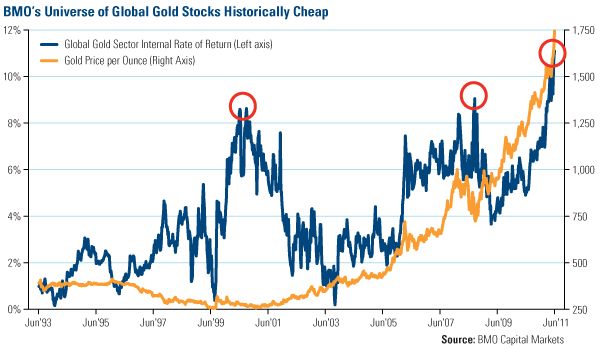
Using the implied value of a defined group of global gold stocks, BMO calculated the internal rate of return to measure how gold stocks have underperformed compared to the yellow metal. Over a period of nearly 20 years, BMO’s group of global gold stocks has never been this inexpensive. Only twice—during the Tech bubble in 2000 and the financial crisis of 2008—has the internal rate of return compared so closely with the price of gold bullion.

BMO's Universe of Global Gold Stocks Historically Cheap

RBC Capital Markets also sees potential in unpopular, undervalued gold equities and urges readers to take “a fresh look” at gold companies. RBC says gold companies currently have margins that are at record highs and it believes margins could be approximately $1,200 an ounce for the next 12 to 24 months. This is substantially higher than the 10-year average of $320 an ounce. Comparatively, many current projects were economically sound at $700-$1,000 per ounce gold prices, creating $300-500 an ounce margins.

Right now, BMO calculates the total cost to produce an ounce of gold at roughly $900 an ounce, while the company can turn around and sell that ounce for upwards of $1,400. This puts margins near 40 percent, roughly twice what they were in 2007 and four times higher than in 2000.

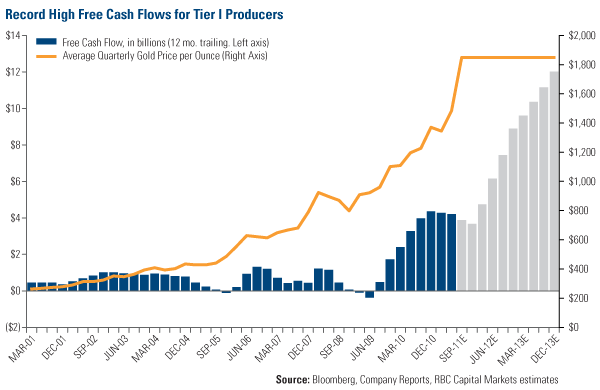
Increased profit margins put more money in gold company coffers and this is reflected in the unprecedented amount of free cash flow (FCF), RBC says. The firm says the industry has reached an inflection point with a “substantial wave of free cash flow” coming over the next 1 to 2 years.

You can see this incredible increase in Tier 1 producers, such as Barrick, Goldcorp, Kinross and Newmont Mining. Looking at their trailing 12 months of free cash flow over 10 years, FCF never rose above $2 billion. However, following the trend in gold prices, FCF among these Tier 1 companies stair-stepped up to $4 billion.

Record High Free Cash Flows for Tier I Producers

Looking forward over the next few years, RBC estimates that if the price of gold remains at $1,850, FCF should stair-step even further, reaching nearly $12,000 by the end of December 2013. BMO estimates the global gold companies will accumulate net cash of $120 billion by 2015 if gold prices remain elevated.

Rising FCF is especially relevant to shareholders, as it allows the gold company to use that money to invest in projects that should enhance shareholder value. This could include pursuing new projects, making acquisitions, reducing debt or paying dividends. Many gold companies are opting for the latter and increasing dividends but these increases haven’t kept up with the pace of rising earnings. The average payout ratio was roughly 20 percent in 2008 but currently sits around 10 percent in 2011.

BMO says, “A dividend policy linked to the financial performance of the company offers investors additional leverage to the gold price. The provision of a meaningful and sustained dividend has the potential to broaden investor appeal and to instill fiscal responsibility for management.”

BMO says gold stocks are currently trading at historically cheap levels, which the company sees as an opportunity investors can take advantage of.

RBC attempts to quantify that opportunity by saying:

“if gold prices remain elevated and/or investors accept a higher long-term gold price, we could see 25-50 percent upside in equities.”

Friday, August 26, 2011

How To Build A Stockpile To Save Money

A stockpile is a collection of nonperishable goods beyond what you need for day-to-day use. People rely on stockpiles to sustain themselves during tough economic times and natural disasters. They also incorporate them into their daily usage to lower their monthly expenses and eliminate last-minute trips to the store.

Anyone can benefit from building a stockpile. Even if you live in an apartment and have a limited amount of space, by changing the way you think about food shopping, you can use your regular pantry space for stockpiling.

The key to using stockpiling as a money-saving method is to acquire the goods at the lowest prices possible.

What Should You Stockpile?

A stockpile should consist of food, household items and toiletry items that you use on a regular basis and that have a long shelf life. You might want food items like bottled water, protein bars, canned goods, dry goods and pet food; household items like paper towels, cleaning products, batteries, light bulbs and trash bags; and toiletries like shampoo, toilet paper, contact solution, medicine and first aid supplies.

Your stockpile might also include items that you don't use regularly, but that would be helpful in an emergency. Make sure to have items in your stockpile that don't require cooking for just such an emergency.

How Much Do You Need?

The size of your stockpile should be based on the number of people who will rely on it, how quickly you will go through the items and how much space you have to store it. Any stockpile is better than no stockpile if you have exactly one cabinet shelf to spare, create a mini stockpile that's focused on the most essential items. If you have an entire spare room for your stockpile, you can include non-essential items like mustard and barbecue sauce.

There is such a thing as a stockpile that's too big. You don't want a stockpile that's larger than the space you have to store it, and you don't want a stockpile that will spoil before you can rotate your way through it (many "nonperishable" items still need to be consumed by a certain date).

Storing Your Stockpile

Being organized is key to keeping your stockpile fresh. Each time you buy something new, put it in the back so you're always eating the oldest items first. Items have expiration dates on them, but they're often hard to see. You may want to use a permanent marker to write the expiration date prominently on the front of the package.

Store your stockpile in a cool, dry, dark place to prevent spoilage. The basement or the garage might work (depending on your climate). If not, you can designate a portion of your pantry, a couple of cabinets or a portion of a closet. For items that will never go bad, like paper towels, under the bed will do nicely.

Amassing Your Stockpile

Unless a hurricane is imminent, you don't need to go to the store one Saturday and spend hundreds of dollars to buy your stockpile. Not only would it put a significant dent in your monthly budget, but you'd be overpaying for most items.

Strategic shopping is the best way to acquire your stockpile. By combining coupons with sales, you can purchase items at extra-low prices. Since it will take several months for sales and coupons to pop up for everything you want to buy, you'll be able to spread out the cost of creating your stockpile.

Maintaining Your Stockpile

Stockpiling is an ongoing process it's not something you do once and forget about. To avoid spoilage, occasionally use items from your stockpile and replace them. That's why it's important to stockpile things that you use regularly. Keep an eye on coupons and sales to replenish your supplies.

Stockpiling Pitfalls To Avoid

  • Don't buy items that will spoil quickly. Loaves of bread don't belong in a stockpile.
  • Don't assume that nonperishable items will never go bad. Rotate through them on a regular basis so that everything gets used before its expiration date.
  • Don't buy things you don't like. Unless you end up in an emergency situation, they're likely to go to waste.
  • Don't neglect nutrition. Many packaged foods are lacking in nutrition at best and outright bad for you at worst. Just because something is cheap or for an emergency doesn't mean you should buy it.
  • Don't pay full price. Stockpiling isn't supposed to be expensive.
  • Don't buy more than you can store. It's okay to get creative about where you store your stockpile goods, but you shouldn't have to look at a collection of soup cans when you're relaxing in the living room.
  • Don't be afraid to go through your stockpile when times are tough. That's what it's there for. You'll replenish it when your situation improves.

The Bottom Line

Stockpiling is a great way to provide for yourself and your family. When times are good, it's convenient; you'll always have what you need on hand, and you'll never have to make a last-minute trip to the store. You'll also cut costs on an ongoing basis by purchasing items on sale and with coupons. And when times are bad, your stockpile means one less thing to worry about.

A Huge Housing Bargain -- but Not for You

The largest transfer of wealth from the public to private sector is about to begin. The federal government will be bulk-selling the massive portfolio of foreclosed homes now owned by HUD, Fannie Mae and Freddie Mac to private investors -- vulture funds.


These homes, which are now the property of the U.S. government, the U.S. taxpayer, U.S. citizens collectively, are going to be sold to private investor conglomerates at extraordinarily large discounts to real value.


You and I will not be allowed to participate. These investors will come from the private-equity and hedge-fund community, Goldman Sachs(GS_) and its derivatives, as well as foreign sovereign wealth funds that can bring a billion dollars or more to each transaction.


In the process, these investors will instantaneously become the largest improved real estate owners and landlords in the world. The U.S. taxpayer will get pennies on the dollar for these homes and then be allowed to rent them back at market rates.


On Wednesday, the Federal Housing Finance Agency (FHFA), the Department of Housing and Urban Development (HUD) and the U.S. Treasury Department issued a Request for Information (RFI) concerning the disposition of the inventory of foreclosed homes owned by the federal government.


An RFI is ostensibly a way for the federal government to get input from the private sector on how to accomplish the goals laid out in the request. But that's really just a facade, as the RFI was structured by the investors to begin with.


In reality, the RFI is a way for the members of Congress to find out if they can get away with bulk-selling these homes to private companies without incurring the wrath of their constituents, taxpayers and former owners of the properties.


Assuming taxpayers don't push back, the next step will be to issue a Request for Proposals (RFP). The RFP will be the bid and plan for these homes by investors.


The way to keep taxpayers from pushing back is to structure the RFI so that the real intention, the bulk sales, is masked by feel-good goals, such as stabilizing neighborhoods and increasing the supply of rental properties.


As intended, the mass media are playing their part in classic style. Every major newspaper in the U.S. has run articles discussing the plan as a rental conversion, allowing readers to assume that Fannie, Freddie and HUD will be renting the properties directly to families who need housing. And although there is an allowance for these kinds of rentals, it is a minor political facade to the obvious true goal of bulk-sale privatization of these homes.


The investors in this program have been waiting for this opportunity since the portfolio of homes owned by HUD began to spike in 2007, when foreclosures surged first in the "Rust Belt," principally Ohio and Michigan.


Since then, of course, the systemic collapse of housing has engulfed all of the major urban coastal regions of the U.S., as well as Phoenix and Las Vegas, and caused the homes owned by Fannie Mae and Freddie Mac, which are now under the direct control of the U.S. Treasury Department, to spike as well.


Even before this crisis occurred, HUD, i.e. the U.S. government, was the largest improved real estate owner in the world, because of its portfolio of foreclosed homes, which is classified as "real estate owned" (REO). The entire massive HUD REO Portfolio is quietly managed by a handful of private firms already, a group listed as Management and Marketing Contractors.


These M&M companies are principally owned by and employ former high-ranking government officials from the various germane agencies -- the Treasury, HUD, FHA and others. And they will provide the necessary access to the current government employees who are tasked with bringing this program to fruition. Once the privatization is complete, those government employees will move from their positions, and many will take up new employment at one of the M&Ms or the new vulture funds.


I am not currently aware of any way for retail investors to participate in this process.


It is probable, however, that once the privatization has occurred and the properties are generating rental income for the investors, the initial investors will cash out by forming real estate investment trusts (REITs), real estate operating companies (REOCs) or limited partnerships (LPs) that will be made available to retail investors.

Japanese investors moving from gold to platinum

Japanese investors have been steadily boosting their platinum investments over the last month, tempted by the precious metal's stability relative to gold as they look to diversify their commodity holdings with global markets in turmoil.

"The amount of gold holdings customers want to sell has grown by the day this month, but purchases of platinum have actually doubled," said Osamu Ikeda, a general manager at Japan's largest bullion house, Tanaka Kikinzoku Kogyo.

Japanese investors have been bucking the global trend for buying gold, cashing in their holdings as bullion smashed through successive record levels.

"I think platinum is ... being bought as price moves are much milder than gold," said Osamu Hoshi, deputy general manager at Mitsubishi UFJ Trust.

The assets of Mitsubishi's physical platinum exchange traded fund (ETF), Japan's first backed by metal stored in the country, had grown by 38 percent since the end of July to 1.62 billion yen ($21 million) as of Aug. 24.

"Buying momentum began early in July but there has been constant buying since late that month, accompanied by rising trading volumes," said Mitsubishi's Hoshi.

The daily average trading volume for Mitsubishi's platinum ETFs exceeded 100 million lots on Aug. 5, and has generally hovered above the average of around 50 million lots for most of this month, Hoshi said.

"While platinum prices are prone to downside risks as they are tied to industrial demand, the metal is more precious in nature than gold and its value is more stable. The fact our ETFs are growing may indicate more Japanese investors are shifting away from physical investment in precious metals."

Tanaka Kikinzoku said it had sold 1,185 kg of platinum for investment purposes as of Aug. 22, up from 666 kg in July, and a nearly three-fold increase from 408 kg in August 2010.

NARROW SPREAD

A downgrade in the U.S. sovereign debt rating and growing worries about its economy, as well as the spreading European debt crisis triggered a rush to buy gold globally, pushing prices to a record high above $1,900 an ounce this week.

But spot gold plunged about 9 percent in just two days after hitting its historic peak.

On the Tokyo Commodity Exchange, the lead platinum futures contract for June 2012 delivery JPLc6 has risen as much as 6 percent this month, much milder than a 17 percent jump for the lead gold futures contract for June 2012 delivery JAUc6.

The spread on TOCOM between gold and platinum, which is usually priced higher than gold, narrowed this month and fell into negative territory for one day in early August.

Other market participants noted there would probably be a flurry of transactions ahead of a revision to tax laws due to take effect from the start of next year.

After the change, those handling the sale of gold and platinum ingots and coins exceeding 2 million yen in value must submit a record of the transaction to tax authorities.

Recession ’100 percent chance’: Peter Schiff

A plunge in recent economic data puts the probability of a double-dip recession [cnbc explains] above 80 percent, according to modeling by Bank of America Merrill Lynch released Wednesday, reflecting the toll the U.S. debt downgrade, Europe’s woes and stock market volatility has taken on economic activity.

The Philly Fed puts a recession probability at 85.7 percent, while the consumer survey puts contraction chances at 80 percent, according to Bank of America’s probability model, which uses a so-called Bayesian technique that “tests if the economy is in a recession based on the interaction of variables that are associated with turns in the business cycle.”

“It’s a 100 percent chance,” said Peter Schiff, CEO & Chief Global Strategist of Euro Pacific Capital. “In fact the recession might have already started.”

“More timely consumer and business sentiment indicators dropped in August in response to a range of bad news,” said Michael Hanson, one of the firm’s economists, in the note. “While we concede the risks are rising, a recession is not baked in the cake. If the economy can avoid further shocks, we would expect a modest bounce in growth into the end of the year.” Source: (1) CNBC

The “financial system” has but one goal now — to prevent people, en masse, from withdrawing their funds from banks. A “run” on the banks would be the end of Depression Lite I and the beginning of Real Depression II. So get ready for more and more fairy tales from the banksters and their political and MSM slaves.

The way economists are trained today, in the Keynesian school, they believe that the economy will pick up if they convince people the economy will pick up. Bernanke is a fool, that is self-evident, but he is not a liar in the strictest sense, because he’s true to his training.

One day this will be completely discredited, and it will be seen that consumption on credit spurred by central banker comments does not produce recovery. It is savings, early-stage investment (that means non-inventory investment for you Keynesians, yes they are very different) and buidling up to production. If that lands when there are healthy savings, you get a healthy economy.

The solution? Less government involvement

It is quite simple really according to the Austrian School of Economics and would appear the Austrians are correct on this score!

The probem of too much debt cannot be corrected by assuming even more debt!

Recessions can be a good thing when wringing bad debt out of the economy in a process Austrians first deemed “creative destruction”.

Central Bankers may delude themselves by futile intervention in vain attempts to correct a liquidity problem when in fact the economy is suffering a solvency problem. Doing so guarantees inevitable and catastrophic depression in lieu of manageable recession as Central Bankers have that Wile E. Coyote moment of realization that the laws of economics inexorably apply no differently than the laws of gravity.

Silver Shield’s Final Warning

One year ago marked the beginning of silver returning to it’s rightful role as money in the world. One year ago silver was at $17.76 an ounce after a very long and drawn out consolidation that went all the way back to St. Patrick’s Day 2008. One year ago was the beginning of silver’s breathtaking run to almost $50 an ounce, a 178% return. Even today, despite the massive paper attack in May and the last two days, we are still up 104% year over year.

When I published the ground breaking Silver Bullet and the Silver Shield article February 25th silver was at $32. On June 27th I said to buy physical silver at $33 silver. Both date’s were very good days to buy and never went below those numbers. Now I am telling you all, for the last time, buy physical silver. I will be taking this weekend to make every effort I can to make those that have been wavering in their purchase of physical silver, to make the commitment and to do it before the end of this month. I believe that we are on the knife’s edge of a major shift that will make silver untouchable if you do not secure your metal right now.

The end of this month marks a seasonal shift for silver investors and the end of the “sell in May and go way.” With the expiration of the CRIMEX contract today and with Bernanke’s possible announcement of QE3 tomorrow, this could be that last, best time in your life to buy physical silver. If you look at this 37 year seasonal chart for silver you can see that the last week of September is the beginning of a very strong seasonal move in silver that should take us into another strong run all the way into February. If we get something similar like we did last year and it runs until May, we could see $100 silver early next year.

I do not believe we will see $100 silver, because of the massive fraud in the metal suppression business will make silver unattainable. Silver and gold are direct competitors to the Dollar. The folks at the Fed, the Treasury and JP Morgan do not want to see silver rise in price. They suppress the price, because if silver rose that would mean that the basis for all of their power, the dollar, would become worth less and eventually worthless. Andrew MacGuire exposed this fraud and nearly paid with his life in a very suspicious hit and run. His claim is that there is 50 to 100 times the amount of paper traded for every physical ounce of real silver and gold. Just look at all of the manipulation in the May silver drive by shooting I reported on. The Elite use a myriad of paper schemes to suppress the price of the physical metal. They all work rather effectively, until the day comes that they cannot deliver on what they promised.

This coming seasonal silver bull run will coincide with a collapse in the dollar and the world’s paper markets. There will be a rush of humanity into anything of real tangible value. Unfortunately, there is going to be a lot of upset people who think they have gold and silver, only find out that they only have nothing. If you don’t hold it, you don’t own it. When this new reality becomes evident to those that do have the metal, they will not part with it for some paper money that they did not want years before. (Read: The 11 Mentality Shifts of Silver Investors.) That shift can happen in the span of a few days. With the length of time I know it takes to move money around, if you wait until “it” happens, it is too late. (more)

Thursday, August 25, 2011

Time To Buy Bulk In Costco Stock? : BJ, COST, TGT, WMT

One of Michelle Obama's favorite stores, J. Crew, opened its first Canadian location August 18 to crowds of disappointed customers. It turns out the retailer is charging around 15% more in Canada versus the U.S. for the same item, this at a time when the Canadian dollar is worth more than the U.S. dollar. As a Canadian, I find this price gouging abhorrent. However, it's good to know not all American retailers are so driven by greed. Costco (Nasdaq:COST), which has been in Canada since 1985, understands that Canadians know how to comparison shop. As a result, it tends to sell items for the same amount on both sides of the border. Its fair pricing policy is one of many reasons to own the big-box retailer's stock. Here are some others.

Same-Store Sales

Costco had a strong July to go along with an even better June, and with one month left in its fiscal year. Double-digit same-store sales growth in fiscal 2011 is looking very realistic. Year-to-date, same-store sales are up 10% due to 7% growth in the U.S. and 16% internationally. Averaging 12% for the June-July period, it beat both BJ's Wholesale (NYSE:BJ) and Target (NYSE:TGT), which averaged 8.3% and 4.3% respectively. Wal-Mart (NYSE:WMT) doesn't report monthly sales, nor does it report quarterly comparables for its non-U.S. stores. Costco stores continue to benefit from a difficult economy. Costco, to a certain extent, transcends income levels, but certainly its average customer possesses a higher income than those at Wal-Mart.

Stock Performance

As they say in the mutual fund ads, past performance is not an indicator of future success. While that's true to an extent, knowing that Costco's stock has been in the black in nine out the last 11 years, including this year, when the S&P 500 is down almost 10% with four months to go, should be reassuring. Successful investing isn't always about hitting homeruns, but simply getting on base. Averaging 15% total returns over the past 15 years with most of it coming from capital appreciation rather than dividends, its stock is about as solid as they come; especially when you consider its ability to generate revenues and profits in good times and bad. Not many retailers can match it.

Valuation

This is where it gets tricky. Currently, Costco's enterprise value is 8.9-times EBITDA. That's much higher than both Wal-Mart and Target. Further, BJ's Wholesale sold itself earlier this summer to Leonard Green & Partners and CVC Capital Partners for $2.8 billion or 6.2 times EBITDA. In addition, Costco's trailing 12-month P/E ratio is 23.4, considerably higher than the S&P 500's at 13.6. The question is whether this premium is justified. Certainly, over the 15-year period, the answer is a resounding "yes". Costco's return beat the index by 910 basis points annually over those 15 years. Investors are usually willing to pay more for quality. If you're still concerned about overpaying, and you should be with its stock just 11.4% off an all-time high of $83.95; remember that Costco's current valuation is equal to its five-year average for P/E, P/S and P/B. More importantly, its P/S is one-third the index at 0.4 times. Lastly, it's one of the few large retailers with a net cash position on its balance sheet. Smart and safe is always a good combination.

The Bottom Line

CEO Jim Sinegal is 75 years old. The fact that he's still running Costco has a lot to do with its values. J. Crew could learn a thing or two about that. At the end of the day, Costco is a long-term, stick-it-in-the-drawer kind of stock. The future will take care of itself.


China’s Looming Debt Disaster

In the aftermath of Washington’s debt-ceiling debacle, Vice President Joe Biden was in Beijing on Friday, desperately trying to reassure the Chinese government that the American economy is not in a downward spiral.

“And very sincerely, I want to make clear that you have nothing to worry about,” the vice president said.

Whether or not he succeeded in soothing his hosts’ anxiety remains to be seen. Yet in trying to placate Beijing, the vice president was making a major miscalculation. China may own $1.2 trillion in U.S. Treasury obligations, but from the get-go, Biden should have eschewed playing defense and gone on the offensive. He should have asked the Chinese to reassure him about their debt problems and, more urgently, their impending economic slide.

Despite all the apocalyptic pronouncements about America’s budget problems, the reality is that the U.S. has a higher credit rating than China and, unlike Beijing, has never repudiated its sovereign debt. More important, the People’s Republic has been understating its debt for years to avoid global attention and criticism.

Indeed, China claims its debt-to-GDP ratio—the standard measure of sustainability—was a healthy 17 percent at the end of last year. Yet Beijing-based Dragonomics, a well-respected consultancy, put China’s ratio at 89 percent—about the same as America’s. Worse still, a growing number of analysts think the Chinese ratio was really 160 percent. At that astronomical level, China looks worse than Greece.

The wide discrepancy in estimates is due to the so-called hidden debts. The largest of these off-the-books obligations have been incurred by local governments and state banks. Yet there are other components, including central-government debt incurred for municipal and local projects, Ministry of Finance guarantees related to partial bank recapitalizations, and miscellaneous obligations such as grain-subsidy payments. No one actually thinks Beijing will default on its outstanding external debt, but these hidden obligations matter; to work down the crushing debt load, the country’s technocrats are adopting strategies that will cripple growth for a decade, maybe longer. (more)

How Much Gold Do You Need, Must Read.

By Dan Steinhart, Junior Analyst

Casey readers of any duration already know how to avoid silent robbery by inflation: own gold.

Since the beginning of 2002, according to the CPI (which famously understates inflation), the dollar has lost over 20% of its purchasing power, a precipitous decline in less than 10 years. During this period, gold owners have not only protected themselves, they've most likely profited in both nominal and real terms. But for all of the non-gold bugs just now awakening to the doomed reality of the dollar, how much gold is actually needed to protect yourself from inflation?

Probably less than you think. The graph below charts the purchasing power of a hypothetical portfolio; each line represents a different allocation between dollars and gold, from 100% dollars to 100% gold and everything in between:

(Click on image to enlarge)

Let's start from the bottom with the dismal dollar: unsurprisingly, if you held no gold, your purchasing power would have dropped in conjunction with the dashed gray line, down to about 78% of its 2002 level.

But the next data point may surprise you. The dashed red line line represents a cash/gold allocation that would have maintained purchasing power at 2002 levels. How much gold would you have needed to hit this breakeven point? Only 5.75% of your portfolio! Even a gold skeptic could handle that tiny allocation: for every $30,000 in your portfolio, keep one gold eagle coin, and you're covered against inflation.

Of course, just because that worked for the last 10 years, it doesn't guarantee it will be enough for the next 10. Inflation will likely ramp up at some point in the near future, and when it does, you'll want more gold. But the point remains: holding just a little bit of gold does wonders to combat inflationary erosion of your cash.

Now that we know how to break even, let's step it up a notch. We here at Casey Research recommend a 33% allocation to gold. Under such an allocation, your purchasing power would not only have been preserved, it would have more than doubled in less than 10 years. Not too shabby.

For comparison's sake, we also included how you would've done with allocations of gold all the way up to 100%. While we certainly don't recommend such extreme positions, any outliers who held the majority of their portfolios in gold can now buy over 400% more "stuff" than in 2002.

The moral of the story? If you don't own gold, get some. Paper dollars are shrinking before our eyes, so offset (or outpace) your losses with concurrent growth in the value of gold.

Buying Foreclosures At A Bargain Price

If you have the cash, a steady job and the desire to become a homeowner, you may be tempted by the thought of buying a foreclosure. While there are some bargains to be found, you do need some education and some professional guidance before you jump into making an offer.

Types of Foreclosure Purchases

The term "foreclosure" gets tossed around a lot, and generally refers to properties that have been repossessed by the lender because the homeowners were unable to pay their mortgage. Some foreclosures are owned directly by a bank, but others are owned by Fannie Mae, Freddie Mac and HUD. Some foreclosures are sold through real estate agents, while others are sold at auction.

Financing

The first step you should take if you want to buy a foreclosure is to consult with a lender. No matter which method you use to buy a foreclosure, or who you buy it from, you will need financing. Be prepared to document your income and assets, and to have your debt-to-income ratio and your credit history reviewed. If you are purchasing the home as an owner-occupant, you may have more financing options than if you are purchasing as an investor, since there are some special financing incentives from government agencies to encourage buyers to purchase a foreclosure and live in it. Investors generally need to make a higher down payment when purchasing a home, often as much as 25% or more.

You can buy a foreclosure with FHA, VA or conventional loans provided the home meets the loan guidelines for condition. One option that many foreclosure buyers have taken advantage of is an FHA 203(k) loan that allows you to wrap renovation costs into the mortgage.

Of course, if you can pay cash, you'll find it much easier to buy a foreclosure.

Pricing

Many buyers assume that buying a foreclosure means you are getting a bargain, but this is not always the case. Banks that are selling foreclosures are hoping to recoup as much of their costs as possible, so, if the property is in good condition, it may be listed at market value or just below market value. Homes that are priced extremely low may be in terrible condition or the bank may also be hoping to encourage a bidding war. Foreclosures in some markets receive multiple offers and can end up selling far above the list price.

If you become involved in a bidding war, or are purchasing a home at an auction, make sure you know your comfort level with your mortgage payment and have worked with a real estate agent to evaluate the market value of homes in your area so that you don't overpay.

Condition

Foreclosures are sold as is, which means that while you can have a home inspection for knowledge of the property, the owner (the bank or government agency) is under no obligation to fix anything. Some foreclosures have been vandalized and will lack appliances and even kitchen cabinets, while others have been vacant for so long, that they have issues with mold or other damage. On the other hand, some foreclosures have been maintained or even improved with some new appliances, fresh paint and new carpet. Just make sure you are aware of the condition and understand the costs you may incur if you have to make repairs. A bargain isn't such a bargain if you need to spend thousands of dollars to bring the home to a livable condition.

Incentives

Fannie Mae offers special financing and incentives to buyers of its foreclosures through its HomePath program, including closing cost assistance up to 3.5% for owner-occupants and low down payment loans.

Freddie Mac offers its First Look program to owner-occupants that allows them the first chance at buying one of its foreclosures before investors are allowed to make an offer. The Freddie Mac HomeSteps program includes a home warranty and savings on new appliances.

HUD foreclosures located in areas that need revitalization are available at bargain prices for law enforcement officers, teachers, firefighters and EMTs. The HUD Home Store offers details about HUD-owned homes in every state.

The Bottom Line

Purchasing a foreclosure can be a great way to become a homeowner, but you need to work with a Realtor with experience in foreclosure purchases and plenty of local knowledge to make sure the home you buy is truly a bargain rather than a money pit.

Wednesday, August 24, 2011

Giant Technology Stocks Are Now Too Cheap (AMAT, CSC, GLW, DELL, HPQ, INTC, KLAC, LRCX, MSFT, MU, SNDK, WDC)

The sell-off and market volatility have made it difficult for many nervous investors to either stand pat or even to stay interested in the market when they are more interested in vacations, getting ready for back to school, or even looking for career opportunities. Hard times bring great opportunities. It is exactly times like this that new millionaires are made by picking great undervalued investments. The reality is that there are some incredible opportunities for value investors out there waiting for investors right now.

Value for the sake of value may never seem like a true catalyst on the surface. In fact, it usually requires an outside economic event or an internal event that creates that next catalyst. All value investors know two things for long-term picks: first is that the value has to be cheap enough to be worth what may be a very long wait, and second is that when the catalyst arises much of that great opportunity may have already been missed. The town crier may be telling you that many of the great tech stocks are just too cheap today, even if there is a lack of catalysts and even if there is no assurance that the absolute bottom has been seen in the market. One upcoming catalyst could be the calendar: investors have historically preferred to buy technology shares shortly ahead of the fourth quarter.

The old rule of thumb is that stocks should trade at roughly 15-times earnings, with a premium or discount applied to growth and to certain industries. That number may be 12-times or 13-times earnings now. Most value investors also use 3.0-times book value as the basic line for “value.” 24/7 Wall St. has found 12 great technology giants at steep market discounts that are all rather well-known with long histories, they trade at less than 10-times current earnings, they also trade at less than 10-times forward earnings, they have large cash balances, most are at very low multiples of book value, and they are all down considerably from recent highs and highs of the past five years.

The late-summer technology value picks are as follows: Applied Materials Inc. (NASDAQ: AMAT); Computer Sciences Corporation (NYSE: CSC); Corning Inc. (NYSE: GLW); Dell Inc. (NASDAQ: DELL); Hewlett-Packard Co. (NYSE: HPQ); Intel Corporation (NASDAQ: INTC); KLA-Tencor Corporation (NASDAQ: KLAC); Lam Research Corporation (NASDAQ: LRCX); Microsoft Corporation (NASDAQ: MSFT); Micron Technology Inc. (NASDAQ: MU); SanDisk Corporation (NASDAQ: SNDK); and Western Digital Corporation (NYSE: WDC).

Looking for value is usually tricky as there is generally a reason for such a low valuation. Earnings that make up that P/E might not live up to expectations, cash reserves can be chewed up, analysts often change their targets and many fail to trust that the value is reflecting uncertainty in the markets. This will show you the good and the bad in these uncanny technology values.

Applied Materials Inc. (NASDAQ: AMAT) is the king of chip cap-ex and it carries a $15 billion market value. The company usually trades with a lower-than-market earnings multiple, but as the leader this one has always managed to come back. The stock trades at only about 9.6-times current earnings and trades at about 8.7-times forward earnings. It also trades at only about 1.8-times book value, it carries little long-term debt, and its cash and investments are listed as being close to $4.6 billion combined. It also carries a 3% dividend yield. At $11.44, the 52-week trading range is $10.27 to $16.93 and this was above $22 back in 2007 and shares went under $9.00 at the selling zeniths of late-2008 and early-2009. (more)